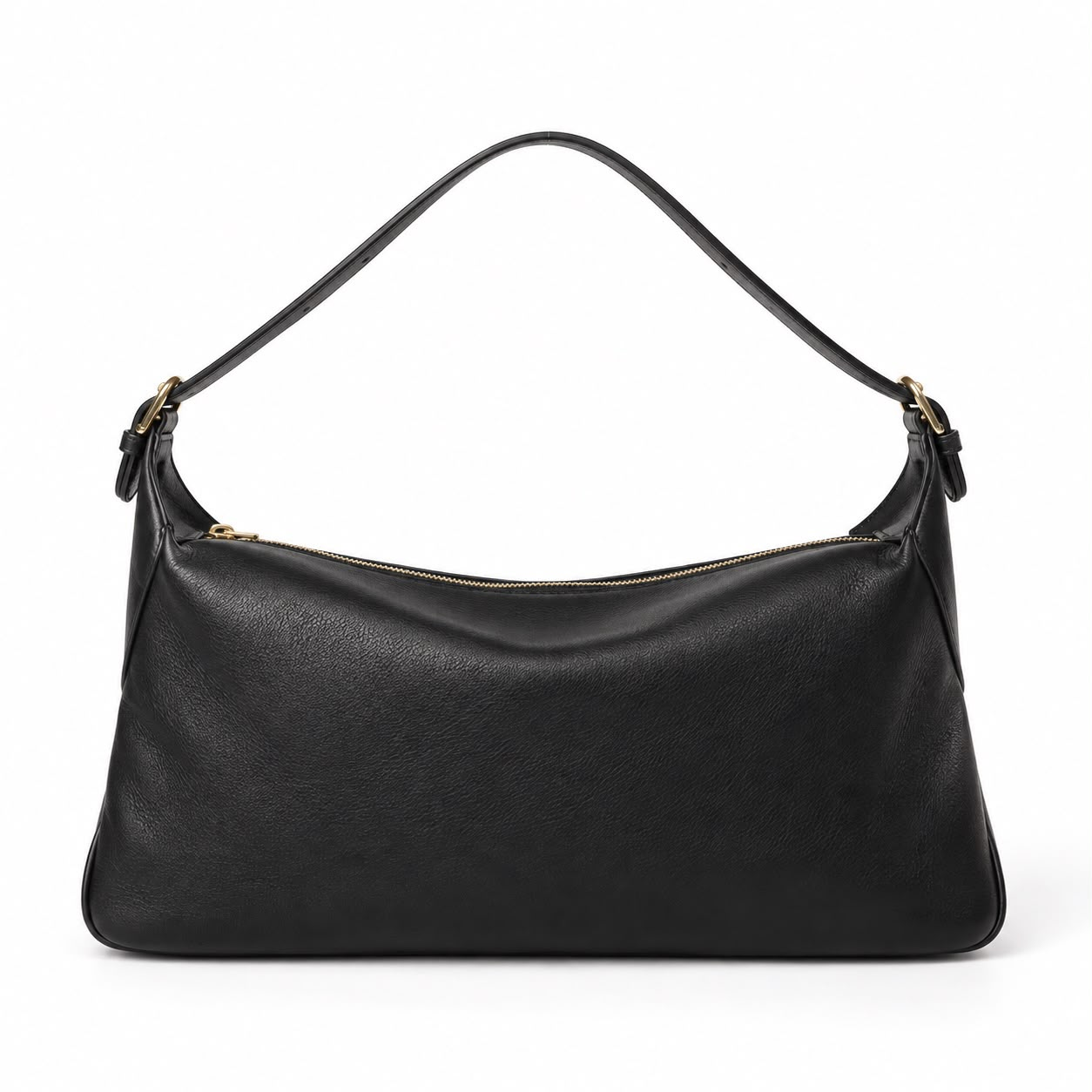
East-West Shoulder Bag
Black leather east-west shoulder bag with an adjustable flat strap, gold-tone hardware, and a top zipper closure.
The same factories that produce for houses like Celine and Balenciaga can produce this piece, directly to you
GABI
Make it yours
Colour
- Main Fabric: 100% Leather, 1200gsm
- Lining: 100% Cotton
- Hardware: 100% Metal
In 1955, Coco Chanel was tired of holding her bag in her hands. She attached a chain strap to a quilted leather flap bag and put it over her shoulder. She named it the 2.55 -- the month and year she made it. Seventy years later that bag has a two-year waiting list and sells for $10,000. A Hermes Birkin costs approximately $800 in materials and labour to produce. It retails at $10,000 to $500,000. No garment in the encyclopedia achieves that multiple. The leather is not the reason. The reason is that a leather bag, made correctly, does not age. It improves. Every scratch, every darkened corner, every worn edge is called a patina. That is the entire commercial logic of leather goods. The construction is the same at $300 as it is at $30,000. Only the hide changes.
The Structured Handbag -- "The Construction is the Same at $300 as it is at $30,000. Only the Hide Changes."
Leather goods manufacturing has a longer craft history than garment manufacturing. The saddlery and harness-making traditions of medieval Europe established the technical vocabulary -- skiving, edge finishing, saddle stitching, and internal structure -- that remains essentially unchanged in a luxury atelier today. Hermes still assembles its Birkin and Kelly bags one-per-artisan, using saddlers trained in a multi-year apprenticeship. That production method is simultaneously a craft statement and a supply constraint that justifies the waiting list and the price.
The modern accessible leather goods market sits between the commodity tier (PU, split leather, mass China production) and the true luxury tier (full-grain, hand-stitched, Italy or France). Brands including Polene, Mansur Gavriel, and Strathberry have proven that restrained design, honest leather quality, and clean construction at $250-600 retail creates a commercially powerful and highly repeatable model. These brands do not compete with Hermes. They occupy the position of "considered first leather bag" -- and that position has enormous volume.
The leather specification is the first and most consequential decision. Full-grain leather retains the entire hide surface, including natural markings. It is the most durable, develops a patina with use, and is the unambiguous quality standard. Top-grain leather has the surface sanded and a finish coat applied -- more uniform, less prone to visible scratching, the standard for most contemporary premium bags at $250-800. Corrected-grain leather has significant surface correction and an embossed pattern -- the mass-market standard. PU vegan leather is a coated textile, not leather -- legitimate and increasingly sophisticated, but must never be described as leather.
For an independent creator, the crossbody is the correct first leather goods entry. It uses less leather than a tote, has simpler construction than a structured top-handle bag, and is the highest-frequency purchase format in the accessible premium market. A clean, well-made crossbody in top-grain or pebbled full-grain leather with quality hardware, painted edges, and a suedette lining lands at $85-130 and retails at $280-420. That is the Polene and Strathberry entry model.
FAQ
Between $71 and $360 landed. PU crossbody affordable China: ~$71 → $284 retail. Top-grain pebbled crossbody premium Portugal: ~$132 → $397-$464 retail. Full-grain veg-tan luxury tote Italy: ~$360 → $1,079 retail. The leather and CMT together are the primary cost drivers -- hardware and edge finishing are significant add-ons at premium and above.
Full-grain retains the entire hide surface including natural grain and any marks -- the most durable, develops a patina with age, the luxury standard. Top-grain has the surface lightly sanded and a finish coat applied, giving a more uniform appearance and less susceptibility to visible scratching -- the standard for most contemporary premium bags at $250-800. Corrected-grain has significant surface correction and an embossed pattern -- the mass-market standard. Always specify grade on the tech pack.
Skiving is thinning the leather edge with a knife or skiving machine so that when the leather is folded or seamed, the edge lies flat without bulk or ridging. Without skiving, seams on 1.4mm+ leather create raised, hard ridges that are both uncomfortable and visually unacceptable on a finished bag. Every fold line and seam edge on a quality leather bag is skived before assembly. A factory that does not skive is not a leather goods factory.
Three acceptable methods at premium tier and above: (1) Burnished edge -- compressed and polished with a heat tool. Fast, appropriate for vegetable-tanned leather. (2) Painted edge -- minimum 3 coats of edge paint applied by hand, sanded between coats. Most common at premium. (3) Folded and stitched -- leather folded over and topstitched. Specify method, number of coats if painted, and colour on tech pack. Raw cut edges are a quality reject at any price point above affordable.
Solid brass or quality zinc alloy only -- never hollow. Minimum 10 micron gold or silver plating. Specify YKK for all zips (#3 for small pockets, #5 for main closure). Test: 48-hour salt spray, no tarnish. Load test D-rings and clasps at 10kg for 10 minutes. Specify hardware by reference number or submit a physical sample with the tech pack -- never leave hardware to factory discretion.
Yes -- PU vegan leather is a legitimate and commercially growing material. Specify: coated base fabric type, minimum 0.6mm coating thickness, 5,000 flex cycle peel resistance test. Never describe as leather on product page or packaging -- it is a coated textile. Apple leather, mushroom leather, and cactus leather are emerging bio-based alternatives with limited commercial scale and unproven long-term durability. PU is the current viable vegan option.
Suedette (microsuede) at affordable and premium -- soft, protects contents, available in full colour range. Cotton canvas at affordable -- clean, can carry a printed brand pattern. Full leather lining (split leather) at luxury -- most durable, adds weight and cost. Jacquard woven lining for brand signature (LV monogram register). Always include a zip pocket on one side and a slip pocket on the other as the minimum functional interior specification.
The crossbody uses less leather than a tote (3-5 sq ft vs 6-9 sq ft), has simpler corner construction than a structured top-handle bag, and is the highest purchase-frequency format in the accessible premium market. It is the Polene, Strathberry, and Mansur Gavriel entry model. The structured tote is the second product once the crossbody is proven -- same factory, same leather, more leather per unit and higher retail price.
China for all tiers at accessible MOQ (50-200 units). India for heritage leather goods capability at competitive CMT (Kolkata and Chennai). Turkey for EU-delivery leather goods at premium quality. Portugal for Made in Europe positioning at premium. Italy for luxury full-grain hand-finished production (Tuscany). Always confirm the five specialist capabilities before brief: skiving, edge painting, hardware setting, lockstitch, and previous production samples in equivalent leather weight.
3-5 square feet of exterior leather, depending on dimensions. Leather hides are sold by the square foot, average hide 40-50 sq ft, meaning a minimum of 8-10 bags per hide. Always add 15% for wastage when calculating leather consumption -- natural leather has unusable areas (belly, edges). For patterns or texture-directional leather, add an additional 10-15% for layout alignment.
Leather Working Group (LWG) certification for the tannery -- Gold, Silver, or Bronze rating for environmental management. REACH compliance for chemical treatments (mandatory for EU market). For PU vegan leather: OEKO-TEX STANDARD 100 for the base textile and coating. For finished goods: REACH compliance on all hardware (no nickel release above 0.5 micrograms/cm2/week for skin contact parts).
HS 4202 covers handbags, shoulder bags, crossbody bags, and similar containers regardless of outer material -- leather, PU, canvas, and textile all classify under 4202. The sub-classification depends on the outer surface material. Confirm with your customs broker for specific market duty rates -- leather goods duty varies significantly by market and material.